Tag: privacy
-
Electronic shelf labels likely to cost jobs and drive up grocery prices, US report warns
Michael Sainato • The Guardian
Surveillance capitalism strikes again
-

Metasshole 2026.08.23
This is an early iteration of my Metasshole project.
The device is an Adafruit ESP32 Feather V2 with a the FeatherWing OLED attached. The module below runs the buzzer to the right of it.
The goal is for when the device detects Meta AI glasses it sounds the alarm by triggering the buzzer. That buzzer is haptic only, so inaudible. I plan on making a vocal version.
And the name, “Metasshole” … I know everyone is simply calling them “Pervert Glasses,” but I’m building on the “Glasshole” lable we used the last time around with the Google Glass.
Current code:
https://github.com/easykraken/metasshole -
US Law Enforcement Warns of ‘Anti-Tech Extremism’ as AI Hatred Grows
Daniel Boguslaw · WIRED
Spencer Reynolds [senior counsel at the NAACP Legal Defense Fund] says that, despite the real if limited threat posed … a category like “anti-tech extremism” could be drawn so broad as to ensnare peaceful data center protesters, AI skeptics, and anyone with a bone to pick with technology that permeates modern life.
· · ·
“Suspicious activity reports are incredibly unreliable, often about vague or innocent behavior, issued under permissive standards. These reports, often received in large volumes, allow officers to inject their own biases and see what they want to see in the facts.”
· · ·
Among the vaguely defined activities flagged by the Northern Virginia intelligence center as suspicious are “expressed/implied threat,” “observation/surveillance,” “photography,” “testing/probing of security,” and “attempted intrusion.”
-
CBP Tapped Into the Online Advertising Ecosystem To Track Peoples’ Movements
Joseph Cox · 404 Media
An internal DHS document obtained by 404 Media shows for the first time CBP used location data sourced from the online advertising industry to track phone locations. ICE has bought access to similar tools.
· · ·
DHS Office of the Inspector General (OIG) later found both CBP and ICE did not limit themselves to non-operational use. The OIG found that CBP, ICE, and the Secret Service all illegally used the smartphone location data, and found a CBP official used the data to track coworkers with no investigative purpose. CBP and ICE went on to repeatedly purchase access to location data.
-
NYPD: Internet Attribution Management Infrastructure
NYPD · NYC.gov
The NYPD disclosure from February 4th:
The NYPD uses internet attribution management infrastructure, including Ntrepid, to manage digital footprints and allow its personnel to safely, securely, and covertly conduct investigations and detect possible criminal activity on the internet.
. . .
The information that is ultimately accessible to NYPD personnel utilizing this equipment is limited to publicly available information or the information that is viewable as a result of the privacy settings, privacy practices, and access limitations of an internet environment (e.g., chatrooms, social media profiles, messaging applications)
-
EFFecting Change: Get the Flock Out of Our City
EFF · EFFecting Change Livestream Series
Join our panel to explore what’s happening as Flock contracts face growing resistance across the U.S. We’ll break down the legal implications of the data these systems collect, examine campaigns that have successfully stopped Flock deployments, and discuss the real-world consequences for people’s privacy and freedom.
Livestream
February 19, 2026 – 12:00pm to 1:00pm PST -

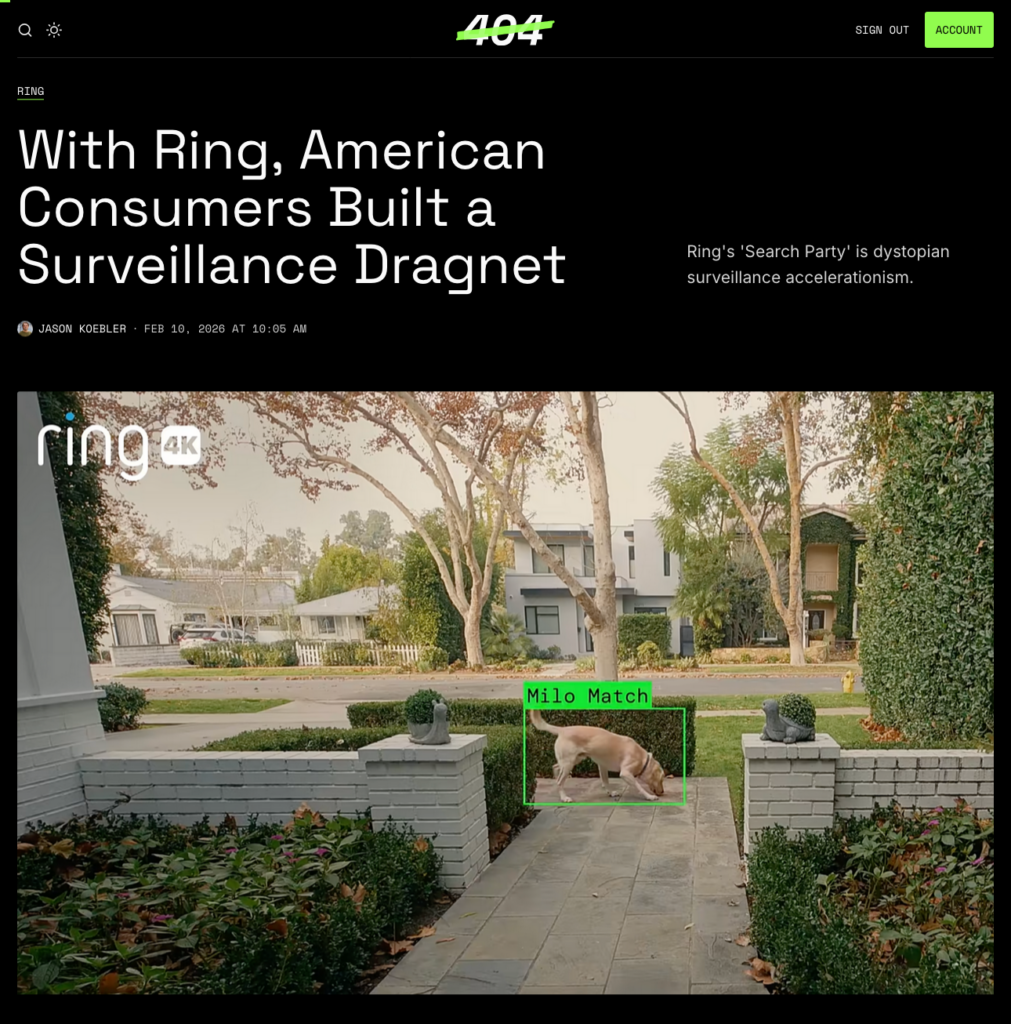
With Ring, American Consumers Built a Surveillance Dragnet
Jason Koebler · 404 Media
Ring had always, explicitly been intended to assist law enforcement. In a series of investigations we did back at VICE (mostly written by Caroline Haskins, who is still covering surveillance at WIRED), we uncovered thousands of pages of documents, emails, and chats via public records requests and leaks that highlighted Ring’s surveillance ambitions. The company threw parties for police, employees wore “FUCK CRIME” shirts to internal parties, and helped police facilitate the retrieval of footage from its customers’ cameras if they initially refused to cooperate.
. . .
With Ring’s recent partnership with Flock, which will further facilitate the sharing of video footage with police, and its new Search Party feature, the message is clear: Ring is still, again, and always will be in the business of leveraging its network of luxury surveillance consumers as a law enforcement tool.
-

Local police aid ICE by tapping school cameras amid Trump’s immigration crackdown
Mark Keierleber of the 74 · The Guardian
Flock of Vultures – Flock of Terror
Police departments nationwide also routinely tapped into the eight Flock cameras installed at the 30,000-student Alvin independent school district south of Houston. Over a one-month period from December 2025 through early January, more than 3,100 police agencies conducted more than 733,000 searches on the district’s cameras, the 74’s analysis of public records revealed. Of those, immigration-related reasons were cited 620 times by 30 law enforcement agencies including ones in Florida, Georgia, Indiana and Tennessee.
. . .
Federal agents “were working directly” with a Carrollton police officer who had access to the Flock cameras “and they asked him to run it and they did”, Hitchcock said. If federal agents ask his office to help them with an immigration case, Hitchcock said, “we will assist them – no questions asked.”