Tag: privacy

  • Hackers Expose Age-Verification Software Powering Surveillance Web

    L0la L33tz · The Rage

    Three hacktivists tried to find a workaround to Discord’s age-verification software. Instead, they found its frontend exposed to the open internet.

    In 2,456 publicly accessible files, the code revealed the extensive surveillance Persona software performs on its users, bundled in an interface that pairs facial recognition with financial reporting – and a parallel implementation that appears designed to serve federal agencies.

    Persona Identity, Inc. is a Peter Thiel-backed venture

    The software performs 269 distinct verification checks and scours the internet and government sources for potential matches, such as by matching your face to politically exposed persons (PEPs), and generating risk and similarity scores for each individual. IP addresses, browser fingerprints, device fingerprints, government ID numbers, phone numbers, names, faces, and even selfie backgrounds are analyzed and retained for up to three years.

    The program, according to the researchers, performs product analytics and user behavior tracking on a government identity-verification platform, provides real-time user monitoring — every click, every page load — on a FedRAMP platform processing PII and biometrics, and includes financial identity-verification capabilities on the government platform.
  • NYPD: Internet Attribution Management Infrastructure

    NYPD · NYC.gov

    The NYPD disclosure from February 4th:

    The NYPD uses internet attribution management infrastructure, including Ntrepid, to manage digital footprints and allow its personnel to safely, securely, and covertly conduct investigations and detect possible criminal activity on the internet.

    . . .

    The information that is ultimately accessible to NYPD personnel utilizing this equipment is limited to publicly available information or the information that is viewable as a result of the privacy settings, privacy practices, and access limitations of an internet environment (e.g., chatrooms, social media profiles, messaging applications)

  • EFFecting Change: Get the Flock Out of Our City

    EFF · EFFecting Change Livestream Series

    Join our panel to explore what’s happening as Flock contracts face growing resistance across the U.S. We’ll break down the legal implications of the data these systems collect, examine campaigns that have successfully stopped Flock deployments, and discuss the real-world consequences for people’s privacy and freedom.

    Livestream
    February 19, 2026 – 12:00pm to 1:00pm PST

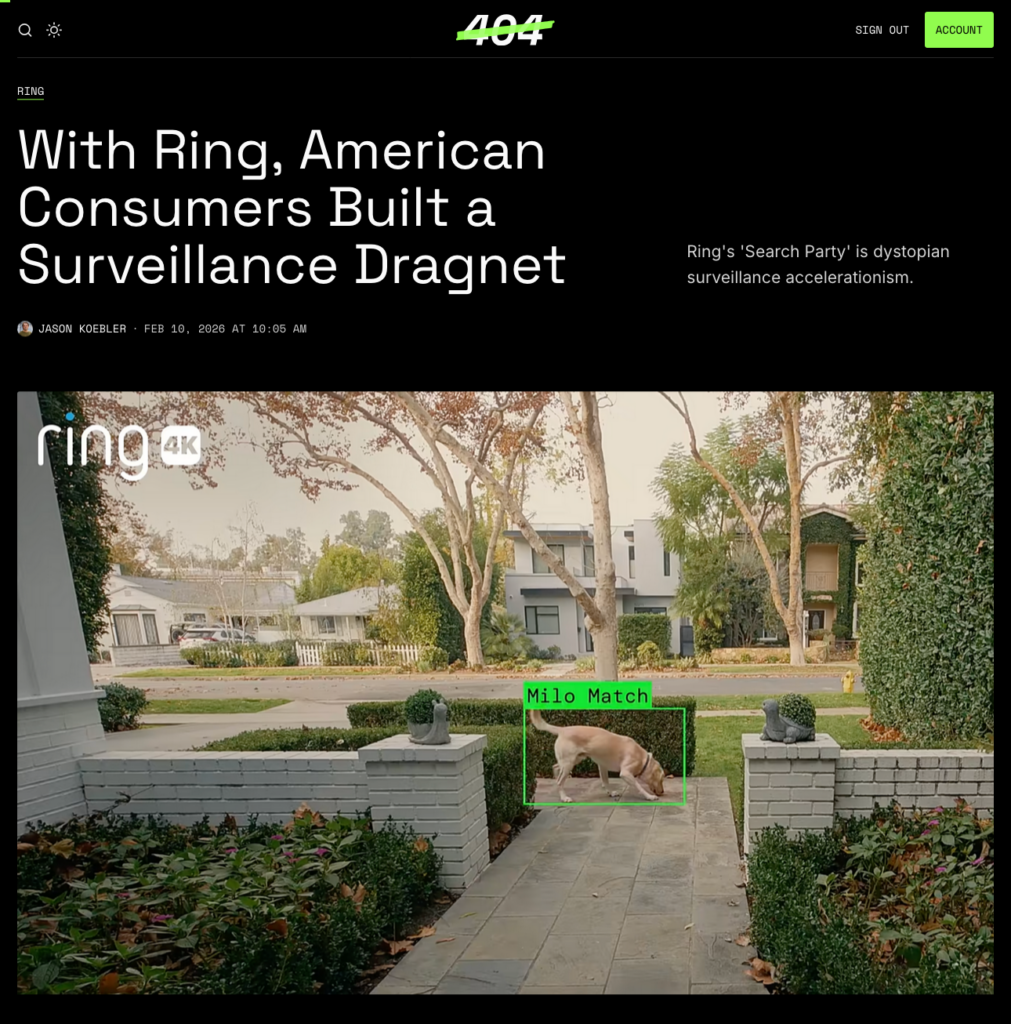
  • With Ring, American Consumers Built a Surveillance Dragnet

    With Ring, American Consumers Built a Surveillance Dragnet

    Jason Koebler · 404 Media

    Ring had always, explicitly been intended to assist law enforcement. In a series of investigations we did back at VICE (mostly written by Caroline Haskins, who is still covering surveillance at WIRED), we uncovered thousands of pages of documents, emails, and chats via public records requests and leaks that highlighted Ring’s surveillance ambitions. The company threw parties for police, employees wore “FUCK CRIME” shirts to internal parties, and helped police facilitate the retrieval of footage from its customers’ cameras if they initially refused to cooperate.

    . . .

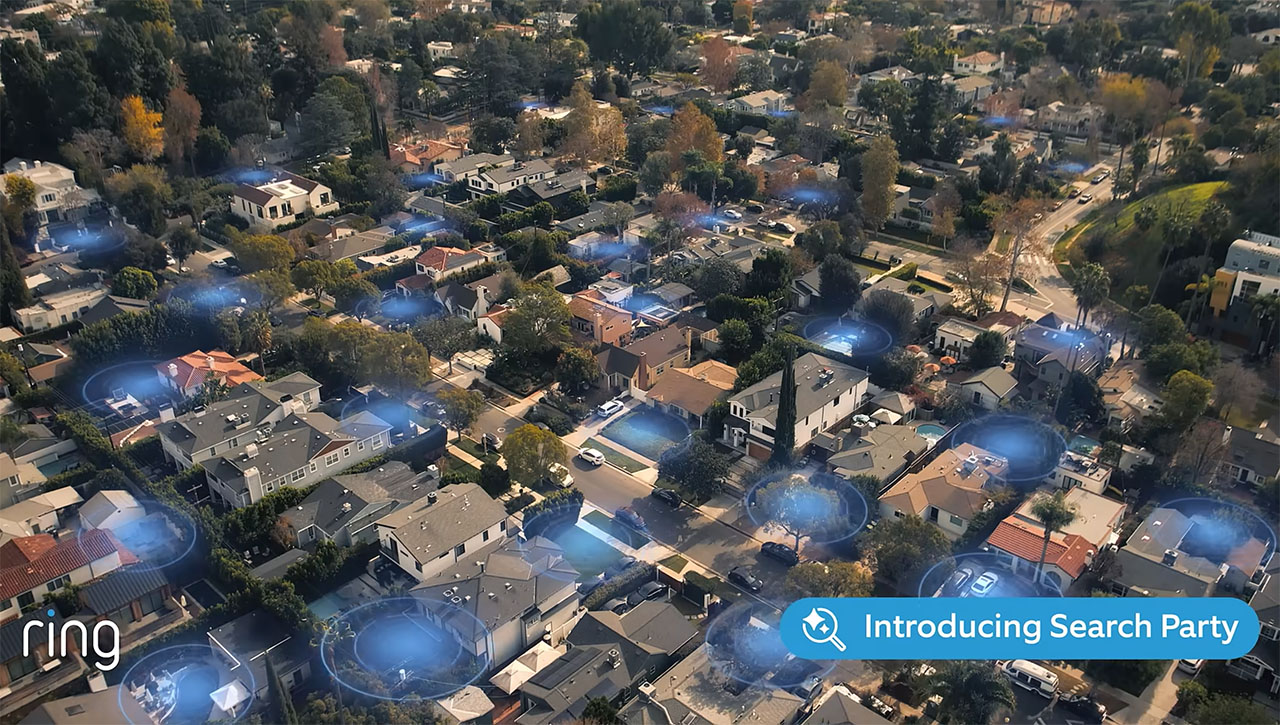
    With Ring’s recent partnership with Flock, which will further facilitate the sharing of video footage with police, and its new Search Party feature, the message is clear: Ring is still, again, and always will be in the business of leveraging its network of luxury surveillance consumers as a law enforcement tool.

    404Media.co screenshot. Article title, "With Ring, American Consumers Built a Surveillance Dragnet". Subtitle, "Ring's 'Search Party' is dystopian surveillance accelerationism." Meta, "Jason Koebler · Feb 10, 2026 at 10:05 AM "

Picture below shows surveillance camera image and a recognized object, a dog with a green rectangle around it and the label, "Milo Match."

  • Local police aid ICE by tapping school cameras amid Trump’s immigration crackdown

    Local police aid ICE by tapping school cameras amid Trump’s immigration crackdown

    Mark Keierleber of the 74 · The Guardian

    Flock of Vultures – Flock of Terror

    Police departments nationwide also routinely tapped into the eight Flock cameras installed at the 30,000-student Alvin independent school district south of Houston. Over a one-month period from December 2025 through early January, more than 3,100 police agencies conducted more than 733,000 searches on the district’s cameras, the 74’s analysis of public records revealed. Of those, immigration-related reasons were cited 620 times by 30 law enforcement agencies including ones in Florida, Georgia, Indiana and Tennessee.
    . . .
    Federal agents “were working directly” with a Carrollton police officer who had access to the Flock cameras “and they asked him to run it and they did”, Hitchcock said. If federal agents ask his office to help them with an immigration case, Hitchcock said, “we will assist them – no questions asked.”

  • Obscura —> Mullvad —> Internet

    Obscura —> Mullvad —> Internet

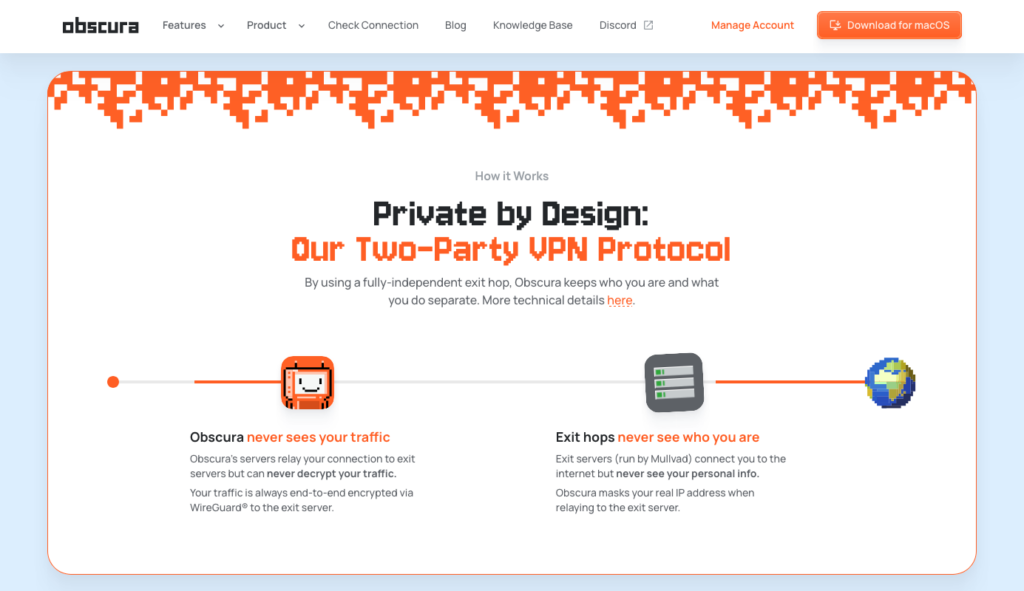
    screenshot from obscura.net. Headline, "Private by Design: Our Two-Party VPN Protocol". 

Body copy left, "Obscura never sees your traffic
Obscura's servers relay your connection to exit servers but can never decrypt your traffic.
Your traffic is always end-to-end encrypted via
WireGuard® to the exit server."

Body copy right, "Exit hops never see who you are
Exit servers (run by Mullvad) connect you to the internet but never see your personal info.
Obscura masks your real IP address when relaying to the exit server."

Pixelated design at top of window holding content. Image of a line drawn to the obscura icon, then to a server icon, then to a globe icon.

Obscura's website header up top with links including "Download for macOS"

    I’m experimenting with Obscura VPN.

    I’m largely curious about how they’re chaining Obscura —> Mullvad —> Internet.

    “Traffic first passes through Obscura’s servers before exiting to the Internet via Mullvad’s WireGuard servers. This two-party architecture ensures that neither Obscura nor Mullvad can see both your identity and your Internet traffic.”
    Via: Mullvad has partnered with Obscura VPN

    According to Obscura’s FAQ:

    Obscura is provably private by design.

    Even “no-logs” VPNs see both your identity and your internet activity, meaning you have to blindly trust their pinky-promise for privacy. This is exactly why some privacy-conscious folks will tell you not to use a VPN at all.

    Obscura is different – we never see your decrypted internet packets. It’s simply impossible for us to log your internet activity, even if we were compelled to, or if our servers were compromised. You can even verify this yourself.

    Obscura’s stealth protocol is much harder to block.

    Our unique stealth protocol is designed to blend in with regular internet traffic. It does so by leveraging QUIC – the same technology that powers HTTP/3 – making it far harder for censors or network filters to detect or block.

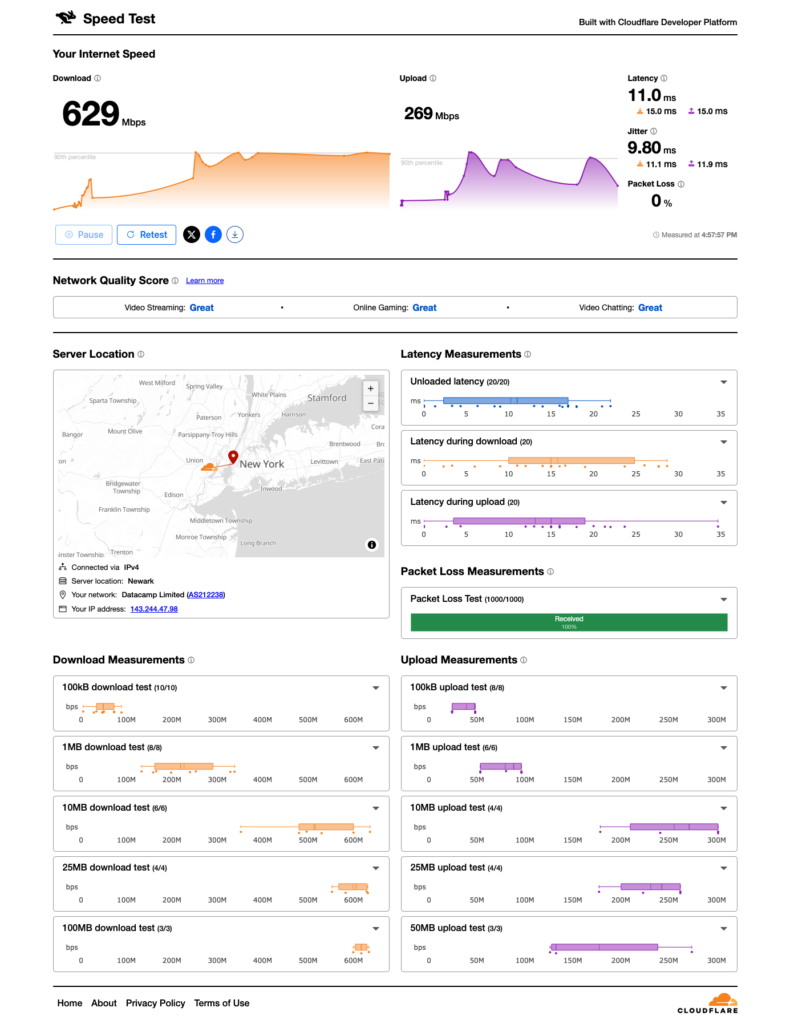
    Not too shabby:

    Screenshot of full speed.cloudflare.com website test results. Shows download and upload measurements as well as latency and jitter. Everything looks pretty snappy.
  • Meredith Whittaker + Signal + You Caring about Privacy

    Meredith Whittaker + Signal + You Caring about Privacy

    The State of Personal Online Security and Confidentiality · SXSW 2025

    Meredith Whittaker making the case for why you should be using Signal.

    No excuses.
    Tolerance has been reduced to zero.

    Hero Image: Jan Zappner/re:publica
    https://commons.wikimedia.org/wiki/File:Re-publica_23_-Tag_1(52952663983).jpg

  • Ring reintroduces video sharing with police

    The Verge

    While I’m already familiar, that Bruce Schneier share got me to take another look at the Ring doorbell relationship with law enforcement.

    This time I caught the heartwarming mention, “Ring is ‘exploring a new integration with Axon that would enable livestreaming from Ring devices.’”

    good lookin’ out

  • Digital Threat Modeling Under Authoritarianism

    Schneier on Security

    The mighty Bruce Schneier breaking down the existing data about us, how it’s collected, how it’s used and what you personally might want to consider given your situation.

    Compute technology is constantly spying on its users—and that data is being used to influence us. Companies like Google and Meta are vast surveillance machines, and they use that data to fuel advertising. A smartphone is a portable surveillance device, constantly recording things like location and communication.

    What’s different in a techno-authoritarian regime is that this data is also shared with the government, either as a paid service or as demanded by local law. Amazon shares Ring doorbell data with the police. Flock, a company that collects license plate data from cars around the country, shares data with the police as well.

    Imagine there is a government official assigned to your neighborhood, or your block, or your apartment building. It’s worth that person’s time to scrutinize everybody’s social media posts, email, and chat logs.

  • Retailers Secretively Using Face Recognition to Spot “Persons of Interest” — Including For the Government

    Jay Stanley · ACLU

    the incorporation of “BOLO” (“Be On the Look Out for”) alerts by companies on behalf of law enforcement has the potential to become — and may already be becoming — a powerful nationwide government surveillance dr­agnet.

    Cute move Rite Aid:

    In 2023 the FTC investigation found that “Rite Aid specifically instructed employees not to reveal Rite Aid’s use of facial recognition technology to consumers or the media.”

    We know the technology makes false positives all the time, and that there’s typically no human in the loop.

    If such sharing networks emerge — much as blacklists of “troublemakers” (i.e., labor organizers) were shared among companies in the 20th century — someone who is falsely accused might find themselves unjustly banned from a significant number of retail stores.

    This article collects a lot of scattered details concerning the issue, so would be a decent jumping off point for your exploration.