The project involved selling the ministry an Artificial Intelligence Platform that uses reams of classified intelligence reports to make life-or-death determinations about which targets to attack. In an understatement several years ago, Karp admitted, “Our product is used on occasion to kill people,” the morality of which even he himself occasionally questions. “I have asked myself, ‘If I were younger at college, would I be protesting me?’”
Mullvad Browser is one of 2 daily drivers. I spin up and down others, but I consistently bounce between Mullvad and Firefox where I’m always running multiple profiles. Wait. Wat?! Why would I make my life so annoying and tedious, you ask?
They’re all out to getcha. This is not a secret. Explore browser fingerprinting for maximum rage inducement.
I prefer to keep aspects of my online life segmented, a separation of concerns. Some things are similar enough that I don’t mind the related sites understanding who I am and what I’m doing there. Dev work and all of it’s associated activity sits in one profile. Newspapers, magazines, library websites and such live in another. Each profile’s cookies, browser histories, fingerprint, etc. remain unknown to the others. For more discretion (within reason) I’ll hit sites via Mullvad where I’m regularly creating new identities, escalating to Tor on occasion … sensitive topics like health.
Juggling all of these browsers def ain’t easy. What if I’m on a page in Firefox but want to open the link in Mullvad? Well, you say, you copy the link, paste it into Mullvad and don’t look back. But if it’s something you rinse and repeat all day it becomes hellish. There is a better way. Didn’t find any existing solution, so I just rolled my own.
WTF is this noise?
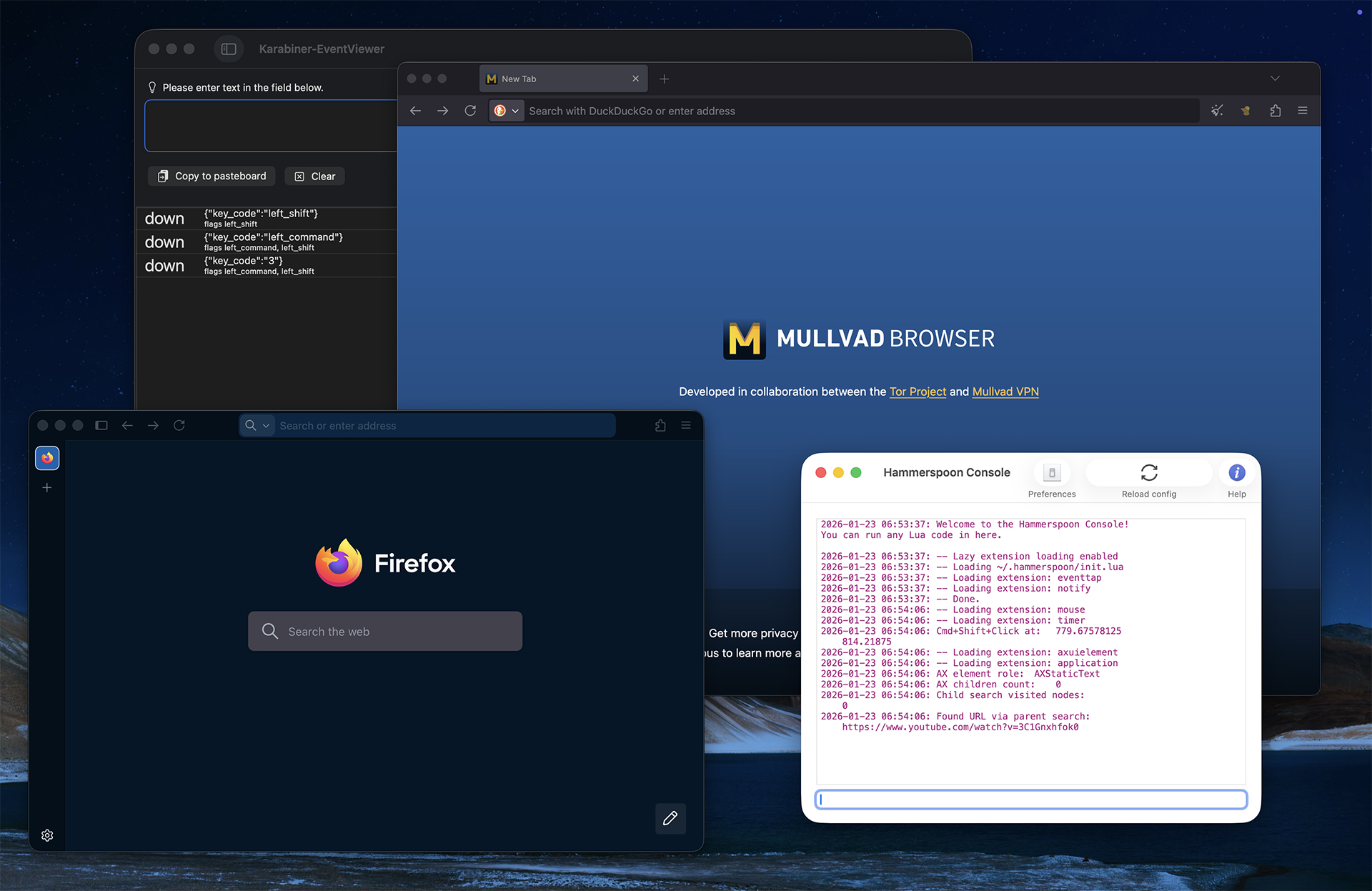
OK. I’ve got the dueling browsers (minimum). And they don’t talk to each other. By installing Hammerspoon and writing a Lua script I’m able to do a Cmd+Shift+Click combo, and with that open the clicked Firefox link in Mullvad. Nice.
The video may be tough to follow, but at about 30s I clear the event viewer, you see that Cmd+Shift are pressed, then a click, then waves hands, link opens in Mullvad Browser.
A floaty banger, that one.
I’d rather not do this with an extension or use other simpler methods as doing so translates to a more unique fingerprint. So then comes the wrastlin: Grab the code. Use the code.
Here’s a high‑level overview of my script, ~/.hammerspoon/init.lua:
Sets up a Cmd+Shift+Click hook using hs.eventtap to intercept left mouse down events.
Targets Firefox only, checking the frontmost app bundle ID against common Firefox builds.
Uses macOS Accessibility (AX) to locate the UI element under the cursor and extract a link URL.
Normalizes AXURL values, handling both string and table formats (like absoluteString).
Searches multiple AX paths for links:
Direct AXURL / AXValue on the element
AXLinkUIElements / AXLinkedUIElements
Child tree traversal (bounded depth + node cap)
Parent chain traversal
Focused element fallback
Opens the URL in the system default browser if found.
The mighty Bruce Schneier breaking down the existing data about us, how it’s collected, how it’s used and what you personally might want to consider given your situation.
Compute technology is constantly spying on its users—and that data is being used to influence us. Companies like Google and Meta are vast surveillance machines, and they use that data to fuel advertising. A smartphone is a portable surveillance device, constantly recording things like location and communication.
…
What’s different in a techno-authoritarian regime is that this data is also shared with the government, either as a paid service or as demanded by local law. Amazon shares Ring doorbell data with the police. Flock, a company that collects license plate data from cars around the country, shares data with the police as well.
…
Imagine there is a government official assigned to your neighborhood, or your block, or your apartment building. It’s worth that person’s time to scrutinize everybody’s social media posts, email, and chat logs.
the incorporation of “BOLO” (“Be On the Look Out for”) alerts by companies on behalf of law enforcement has the potential to become — and may already be becoming — a powerful nationwide government surveillance dragnet.
Cute move Rite Aid:
In 2023 the FTC investigation found that “Rite Aid specifically instructed employees not to reveal Rite Aid’s use of facial recognition technology to consumers or the media.”
We know the technology makes false positives all the time, and that there’s typically no human in the loop.
If such sharing networks emerge — much as blacklists of “troublemakers” (i.e., labor organizers) were shared among companies in the 20th century — someone who is falsely accused might find themselves unjustly banned from a significant number of retail stores.
This article collects a lot of scattered details concerning the issue, so would be a decent jumping off point for your exploration.
Something I try to share with people is the need to test links before you click them. Not all links, but anything suspicious. For me that means anything I receive via email.
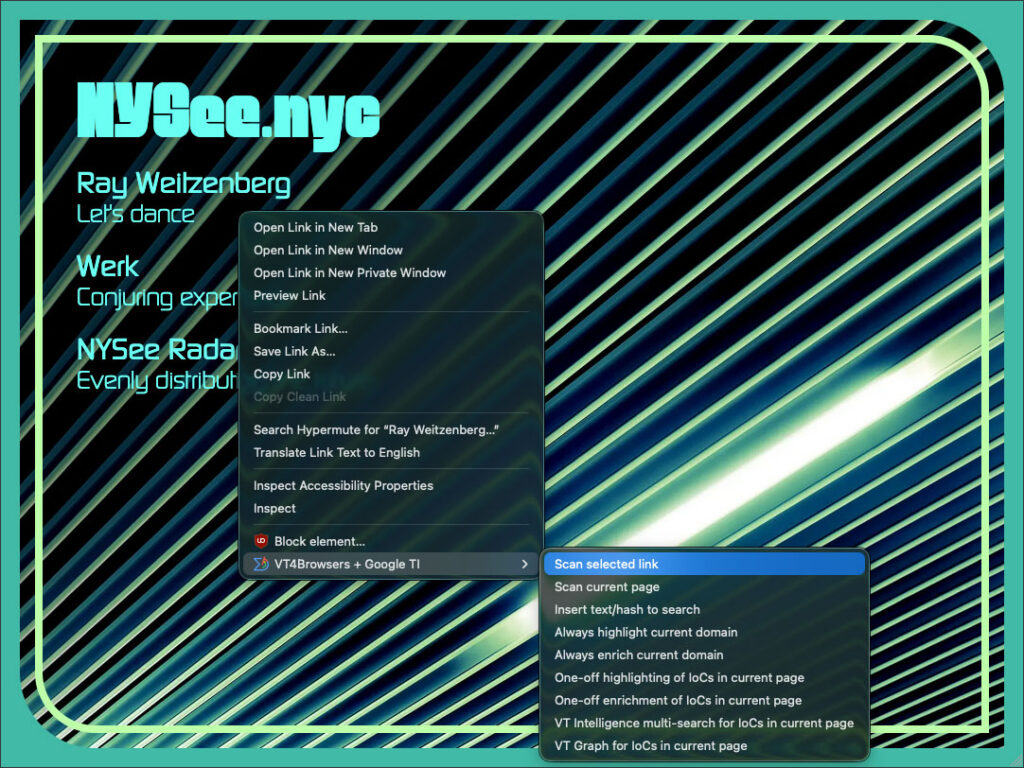
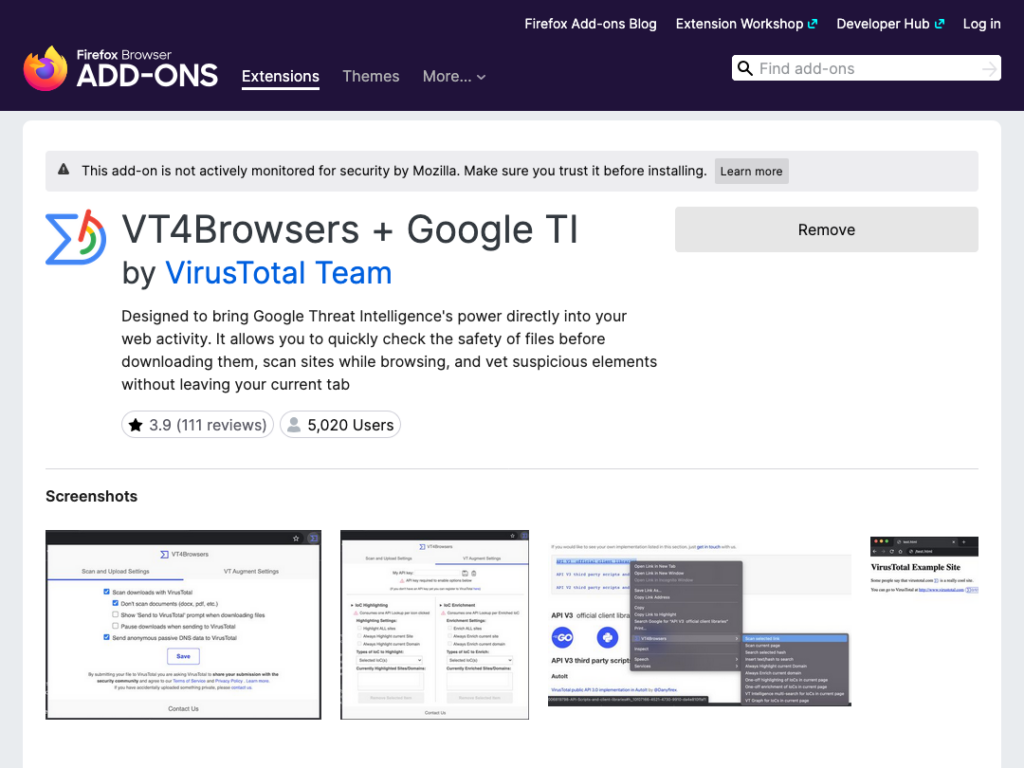
VirusTotal has been a tool/service I’ve been using for a long while. Their browser extension facilitates the scanning of suspicious links by situating the functionality into the context sensitive menu triggered by a right click.
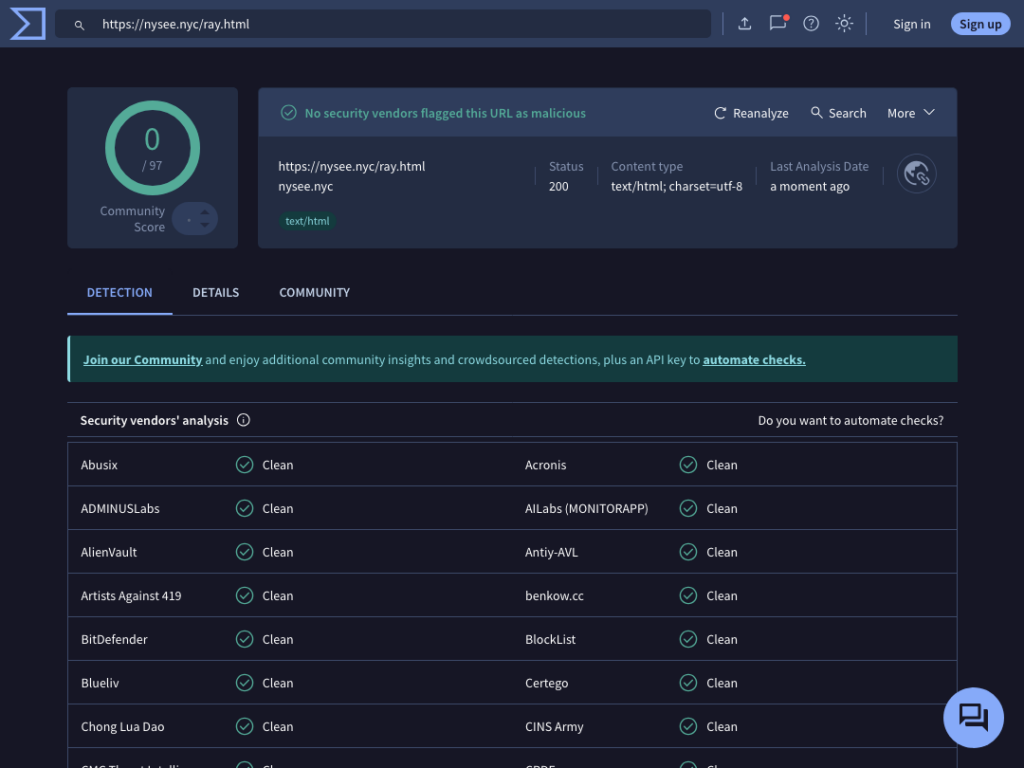
Selecting that menu option triggers the VirusTotal URL scan page to open and initiates the scan of that link. Results of that scan are returned and from those you can decide for yourself if you trust what’s on the other side of that link.
One was the concentration of capital that each machine represented, and the other was the ability of each machine to put a certain number of humans out of work – to be ”worth” that many human souls. … It was open-eyed class war. … If our world survives, the next great challenge to watch out for will come – you heard it here first – when the curves of research and development in artificial intelligence, molecular biology and robotics all converge. Oboy.