Category: Link Blog

  • Ring reintroduces video sharing with police

    The Verge

    While I’m already familiar, that Bruce Schneier share got me to take another look at the Ring doorbell relationship with law enforcement.

    This time I caught the heartwarming mention, “Ring is ‘exploring a new integration with Axon that would enable livestreaming from Ring devices.’”

    good lookin’ out

  • Digital Threat Modeling Under Authoritarianism

    Schneier on Security

    The mighty Bruce Schneier breaking down the existing data about us, how it’s collected, how it’s used and what you personally might want to consider given your situation.

    Compute technology is constantly spying on its users—and that data is being used to influence us. Companies like Google and Meta are vast surveillance machines, and they use that data to fuel advertising. A smartphone is a portable surveillance device, constantly recording things like location and communication.

    What’s different in a techno-authoritarian regime is that this data is also shared with the government, either as a paid service or as demanded by local law. Amazon shares Ring doorbell data with the police. Flock, a company that collects license plate data from cars around the country, shares data with the police as well.

    Imagine there is a government official assigned to your neighborhood, or your block, or your apartment building. It’s worth that person’s time to scrutinize everybody’s social media posts, email, and chat logs.

  • Retailers Secretively Using Face Recognition to Spot “Persons of Interest” — Including For the Government

    Jay Stanley · ACLU

    the incorporation of “BOLO” (“Be On the Look Out for”) alerts by companies on behalf of law enforcement has the potential to become — and may already be becoming — a powerful nationwide government surveillance dr­agnet.

    Cute move Rite Aid:

    In 2023 the FTC investigation found that “Rite Aid specifically instructed employees not to reveal Rite Aid’s use of facial recognition technology to consumers or the media.”

    We know the technology makes false positives all the time, and that there’s typically no human in the loop.

    If such sharing networks emerge — much as blacklists of “troublemakers” (i.e., labor organizers) were shared among companies in the 20th century — someone who is falsely accused might find themselves unjustly banned from a significant number of retail stores.

    This article collects a lot of scattered details concerning the issue, so would be a decent jumping off point for your exploration.
  • Jim Campbell · Encoding Light

    bitforms gallery

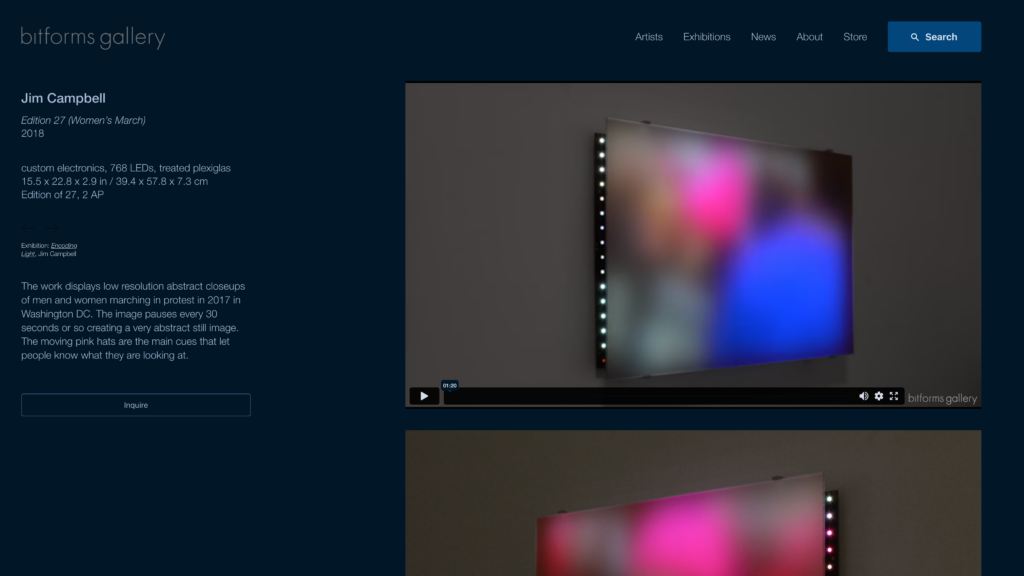
    screenshot of the bitforms gallery website page showcasing the upcoming Jim Campbell show. On the right is a static poster image for a video which shows a piece of art hanging on the wall. the artwork has a blury front face and on the edge of the piece led lights are visible behind the frosted glass front. a bit of the next image is popping up above the fold below. to the right are details about the work

    luv luv luv me some Jim Campbell

    Opening: This Saturday, January 24th, 5 – 7 PM @ the lovely bitforms gallery

  • IS IT O.K. TO BE A LUDDITE?

    Thomas Pynchon · NYTimes

    One was the concentration of capital that each machine represented, and the other was the ability of each machine to put a certain number of humans out of work – to be ”worth” that many human souls.

    It was open-eyed class war.

    If our world survives, the next great challenge to watch out for will come – you heard it here first – when the curves of research and development in artificial intelligence, molecular biology and robotics all converge. Oboy.

    Written in 1984 👆 heh

  • It’s Time for the VPN Industry to Innovate (Obscura Interview)

    Techlore Talks

    You don’t have to trust Obscura—you just have to trust that not both Obscura and Mullvad are compromised.

  • One Year of Trump. The Time to Act Is Now, While We Still Can.

    M. Gessen · NYTimes

    Ask anyone who has lived in a country that became an autocracy, and they will tell you some version of a story about walls closing in on them, about space getting smaller and smaller.

    The only way to keep the space from imploding is to fill it, to prop up the walls: to claim all the room there still is for speaking, writing, publishing, protesting, voting. It’s what the people of Minnesota appear to be doing, and it’s something each of us needs to do — right now, while we still can.

    Screenshot of the hero of the article. Split in half 50/50. Left side has the title "one year of Trump. The time to act is now, while we still can." above that are "opinion" and the author's name "M. Gessen".

Right side is a collage of photographs. The images are from the various events over the last year, musk, trump making a fist, military members, prisoners in a concentration camp, etc.

    Gift link:

  • ‘pain point’ : the maximum amount you are willing to pay

    ‘pain point’ : the maximum amount you are willing to pay

    Noah Giansiracusa · Harvard Law Today

    Retailers are looking for what’s called the “pain point.” That’s the maximum amount that you as an individual customer are willing to pay for a specific product

    [an app’s] knowledge of your phone battery’s life to determine how desperate you might be for a ride home, and therefore charge you more for it

    now imagine … they look at me and they know every video I’ve watched on YouTube, everything I’ve searched in Google, and everything I have liked on Facebook, every conversation I’ve had with an AI chatbot. Does that feel like a fair situation?

    Does that feel like a fair situation?

    The wage slaves of the Gilded Age had it easy

  • At the root of all our problems stands one travesty: politicians’ surrender to the super-rich

    George Monbiot · The Guardian

    There are many excuses for failing to tax the ultra-wealthy. The truth is that governments don’t tackle the problem because they don’t want to