For some time now, I’ve been looking for a solution to house a small Dark Forest. If that’s a new phrase for you, Yancey Strickler proposes, “Imagine a dark forest at night. It’s deathly quiet. Nothing moves. Nothing stirs. This could lead one to assume that the forest is devoid of life. But of course it’s not. The dark forest is full of life. It’s quiet, because night is when the predators come out. To survive, the animals stay quiet.”
This concept has been applied to spaces online over the last few years. I sit in several dark forests built in Discords, Signal groups and a couple much geekier spaces. None are ideal, exemplified in part by the eminent mass exodus from Discord.
So when I happened to catch Yancey Strickler and Josh Citarella announcing the debut of the Dark Forest Operating System I wondered what the strange feeling I immediately felt might have been. I realize now it was hope, something rarely glimpsed these days. heh
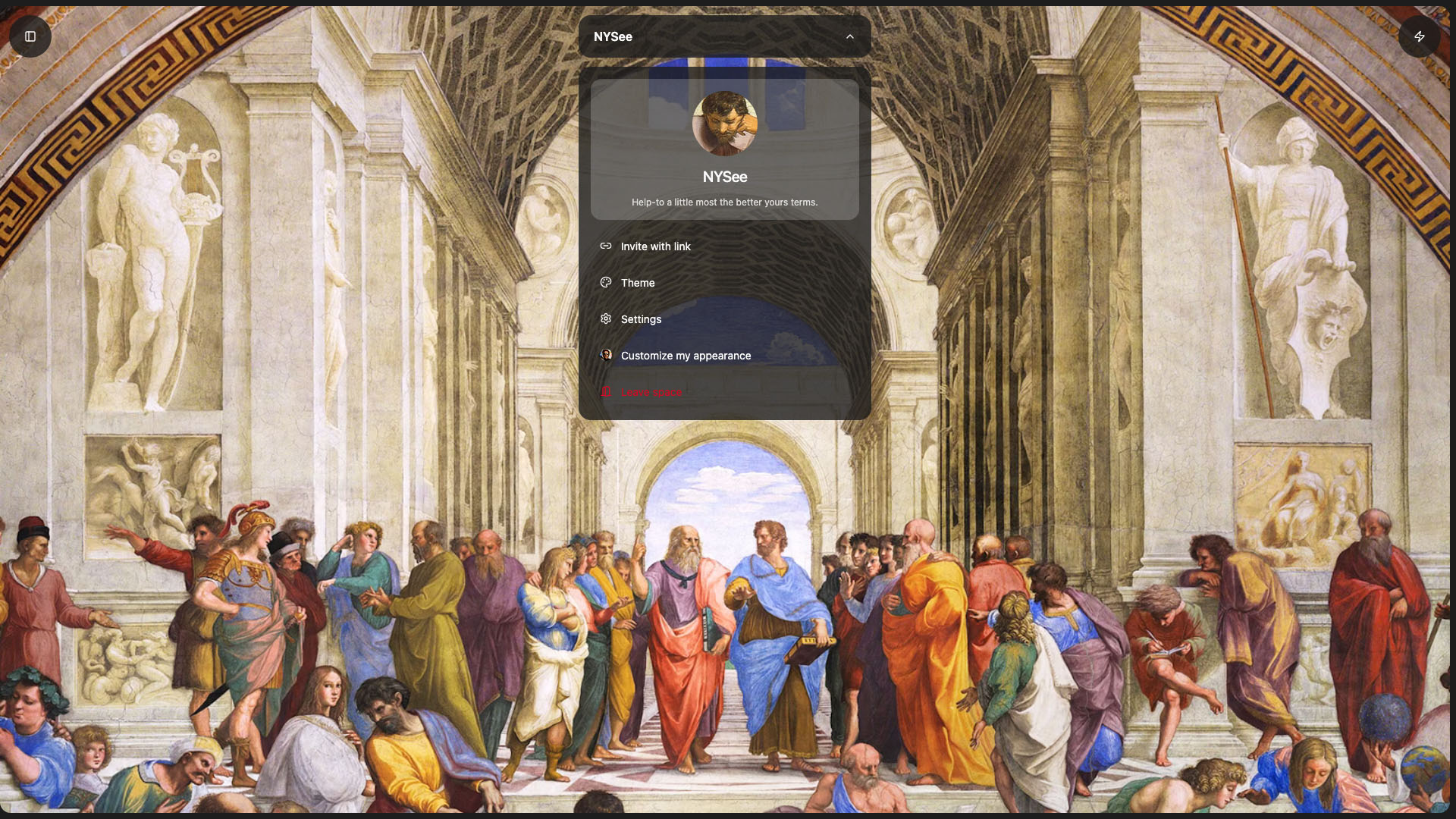
Seeing that the option’s now available, I’ve started building out a first space on DFOS.
WTF is that? .. you ask. Yancey Strickler (the same) presents it well:
Welcome to DFOS
If you’re reading this, you’ve stepped into one of the first spaces on DFOS, while it’s still being built from the inside out. Which raises the question: what is this space?
The problem DFOS solves
Fear grips the web. The internet becomes more hostile. Bots, slop, and trolls overwhelm public space. The internet as we knew it gone forever. People are fleeing the public internet and joining dark forests to feel safe. This is the world that exists today. Not because anyone wants it, but because it’s the timeline we’ve been dealt. We’re doing this in the most haphazard way possible — expensively chaining together a bunch of apps for ourselves and our communities. We do it because there’s no native way to share ownership, run a group treasury, charge for access, and have a private space together. Until now. (*dun-dun-duuuuhhnnn*)
What you’re looking at
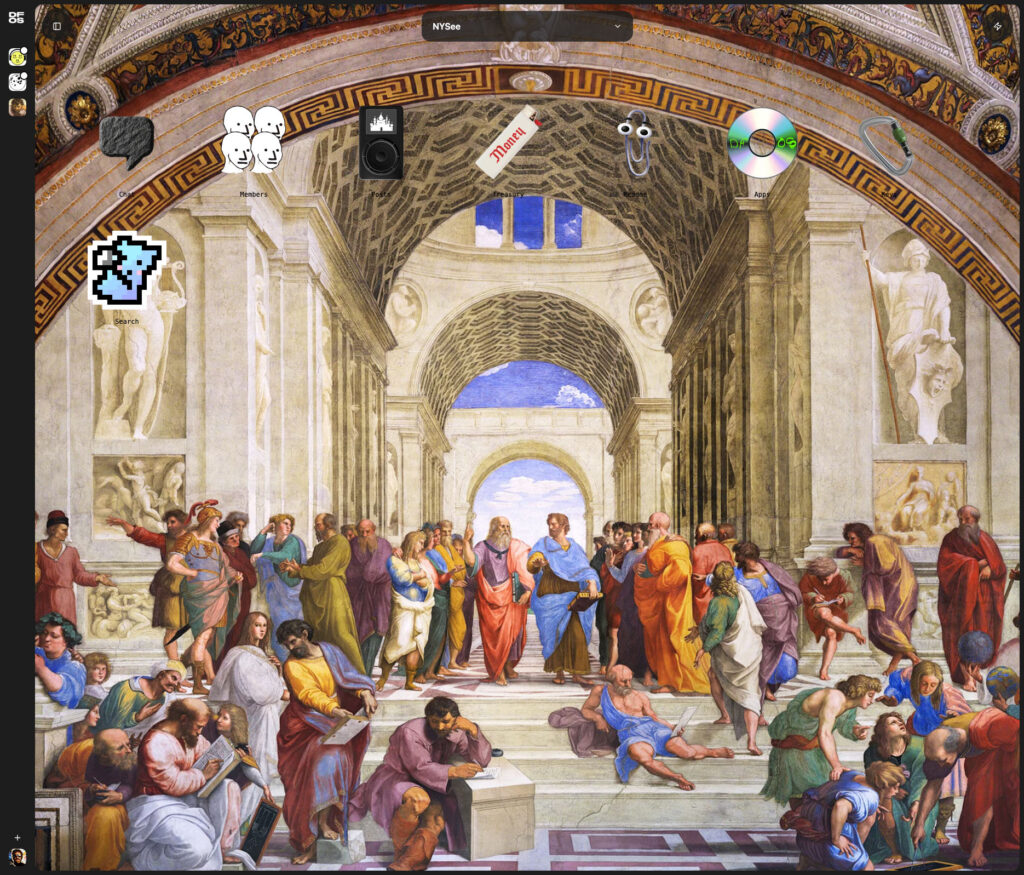
That’s what DFOS is for. DFOS creates shared private internets: members, money, chat, and a private feed in one shared space. Each space starts with six apps:
💬 Chat Auto-disappearing chats and private DMs.
👥 Members Everyone in this space. Closed, open, by application, or paywall — your call.
💰 Treasury Where member fees and sales revenue get split and reinvested into new projects and impact.
📝 Posts Private feed of images, videos, and text from anyone in the space. Upvoted posts can “leak” outside.
📄 Readme Where you explain what your space is about.
🛒 Apps (coming soon) Space to create, generate, publish, and download new apps and functions for your DFOS.
How to use this space
This is your own internet, without scale. A shared private space among a community of people. There’s no wrong way to use it, as long as you’re doing it together. We use DFOS to make DFOS. We use chat to coordinate. We use posts to share ideas. We use the Treasury to pay for specific jobs our community can do better than we can. We make new apps to fill the wants and needs we keep discovering. Your way of using this might be totally different. Our hope is that whatever your needs, the DFOS operating system can support them.
The bigger vision
We imagine a very different internet than the one we’ve recently known. A web where we always know who’s there. Where we no longer assume infinite scale. Where we don’t isolate ourselves. Where we have private spaces to be real with peers rather than performing for the algorithmic gods and their commercial desires.
I was tipped off to Vladimir Ivkovic by Apiento on the excellent Test Pressing who said his set was at the top of his list from Love International last summer.
Vladimir is playing the closing Sunday eve set at Nowadays this weekend, so it seems having him on heavy rotation these last weeks turns may prove to have been a wise conditioning move.
As part of the Gaza war, the Israel Defense Forces (IDF) have used artificial intelligence to rapidly and automatically perform much of the process of determining what to bomb. Israel has greatly expanded the bombing of the Gaza Strip, which in previous wars had been limited by the Israeli Air Force running out of targets.
These tools include the Gospel, an AI which automatically reviews surveillance data looking for buildings, equipment and people thought to belong to the enemy, and upon finding them, recommends bombing targets to a human analyst who may then decide whether to pass it along to the field. Another is Lavender, an “AI-powered database” which lists tens of thousands of Palestinian men linked by AI to Hamas or Palestinian Islamic Jihad, and which is also used for target recommendation.
Precisely what forms of data are ingested into the Gospel is not known. But experts said AI-based decision support systems for targeting would typically analyse large sets of information from a range of sources, such as drone footage, intercepted communications, surveillance data and information drawn from monitoring the movements and behaviour patterns of individuals and large groups.
· · ·
“We work quickly and there is no time to delve deep into the target. The view is that we are judged according to how many targets we manage to generate.”
Although it’s not known exactly what data the Gospel uses to make its suggestions, it likely comes from a wide variety of different sources. The list includes things like cell phone messages, satellite imagery, drone footage and even seismic sensors, according to Blaise Misztal, vice president for policy at the Jewish Institute for National Security of America, a group that facilitates military cooperation between Israel and the United States.
· · ·
“AI algorithms are notoriously flawed with high error rates observed across applications that require precision, accuracy, and safety,” warns Heidy Khlaaf, Engineering Director of AI Assurance at Trail of Bits, a technology security firm.
· · ·
“The nature of AI systems is to provide outcomes based on statistical and probabilistic inferences and correlations from historical data, and not any type of reasoning, factual evidence, or ‘causation,’” she says. “Given the track record of high error-rates of AI systems, imprecisely and biasedly automating targets is really not far from indiscriminate targeting.”
· · ·
While Israel’s use of the Gospel to generate a full set of targets may be unique, the nation is hardly alone in using AI to assist in intelligence analysis. The U.S. is actively working with many different kinds of AI to try and identify targets in the field. One suite of AI tools, known as Project Maven, is run through the National Geospatial-Intelligence Agency, which collects massive quantities of satellite imagery.
· · ·
Ashley wouldn’t comment on any particular AI tool used by the U.S. intelligence community, but he says often these systems will stitch together multiple layers of AI. Some excel at finding objects in images while others can sort through things like radio transmissions . . . “You know the Russians are doing it, you know the Chinese are doing it,” he says.
Three hacktivists tried to find a workaround to Discord’s age-verification software. Instead, they found its frontend exposed to the open internet.
In 2,456 publicly accessible files, the code revealed the extensive surveillance Persona software performs on its users, bundled in an interface that pairs facial recognition with financial reporting – and a parallel implementation that appears designed to serve federal agencies.
…
Persona Identity, Inc. is a Peter Thiel-backed venture
…
The software performs 269 distinct verification checks and scours the internet and government sources for potential matches, such as by matching your face to politically exposed persons (PEPs), and generating risk and similarity scores for each individual. IP addresses, browser fingerprints, device fingerprints, government ID numbers, phone numbers, names, faces, and even selfie backgrounds are analyzed and retained for up to three years.
…
The program, according to the researchers, performs product analytics and user behavior tracking on a government identity-verification platform, provides real-time user monitoring — every click, every page load — on a FedRAMP platform processing PII and biometrics, and includes financial identity-verification capabilities on the government platform.
The NYPD uses internet attribution management infrastructure, including Ntrepid, to manage digital footprints and allow its personnel to safely, securely, and covertly conduct investigations and detect possible criminal activity on the internet.
. . .
The information that is ultimately accessible to NYPD personnel utilizing this equipment is limited to publicly available information or the information that is viewable as a result of the privacy settings, privacy practices, and access limitations of an internet environment (e.g., chatrooms, social media profiles, messaging applications)